OG-0683 Ownership
Jeep Wrangler Headlight Problems: Flickering, Dim LEDs, Snow, Aim and Switch Issues (JK and JL)
By the Offroad Grip editors 7 min read Rev. Nov 22, 2026
Checklist
- NHTSA lists no headlamp recall for 2007 to 2026 Wranglers.
- Base JK and JL headlamps use H13 halogen bulbs; factory LEDs are dealer-serviced.
- Many 2007 to 2012 JK headlight complaints also mention the TIPM power module.
- JL LED headlamps run cool, and owners report snow covering them.
- Jeep says light lens fogging is normal and usually clears with the lamps on.
- NHTSA says no LED bulb is legal in a replaceable-bulb headlamp.
- A lift kit changes aim; have the headlights re-aimed after lifting.
Procedure
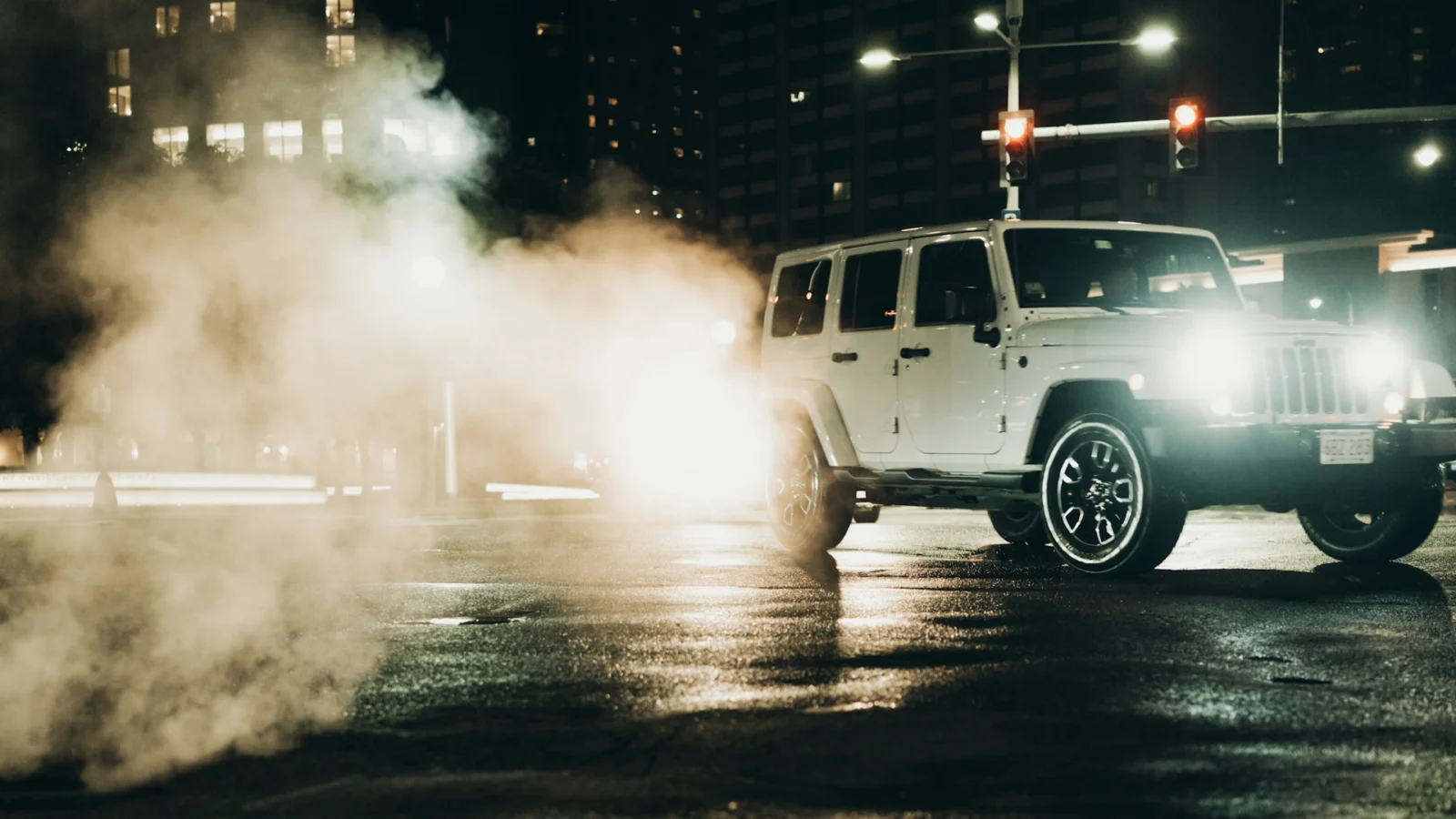
The most common Jeep Wrangler headlight problems are JK headlights that flicker or go out (on 2007 to 2012 models often tied to the TIPM power module), burned-out H13 halogen bulbs, aftermarket LED bulbs that flicker or set bulb-out warnings, lenses that fog, and beams aimed too high after a lift. On the JL, the standout owner complaint is factory LED headlights packing up with snow because they run cool.
There is no headlamp recall to fall back on. NHTSA’s recall database lists lighting recalls for Wrangler tail lamps, side markers, the third brake light and trailer lighting, but none for the headlamps on JK or JL models. That means headlight fixes are owner or shop repairs: bulbs, connectors, switches, power modules and aim.
What NHTSA complaints show by generation
A keyword search of NHTSA owner complaints for 2007 to 2023 Wranglers (data pulled in November 2026) shows how differently the two generations fail. These are unverified owner reports, not a defect finding, but the patterns are useful.
| Model years | Complaints mentioning headlights | Most common theme |
|---|---|---|
| 2007 to 2017 (JK) | About 130 | Headlights going out, flickering or flashing on their own; about 46 of these also mention the TIPM power module, mostly on 2007 to 2012 models |
| 2018 to 2023 (mostly JL) | 16 | 11 describe LED headlights or fog lamps covered by snow or ice |
Check your own VIN on NHTSA’s recall lookup anyway, since open recalls for other systems are common on Wranglers. Our Wrangler problems by year guide lists the major JK and JL recalls.
Quick diagnosis by symptom
| Symptom | Most likely cause | First check |
|---|---|---|
| One headlight out (halogen) | Burned-out H13 bulb | Swap bulbs side to side or fit a new pair |
| Both headlights out, other lights work | Switch, fuse or relay circuit, or the power module | Fuses for the headlamp circuit, then a scan for body codes |
| Flicker that changes over bumps | Loose or corroded connector | Connector at the back of each lamp |
| Flicker or bulb-out warning after an LED swap | Aftermarket LED bulbs or harness | Refit the original halogen bulbs and retest |
| Lights flash with horn, wipers or locks acting up (JK) | TIPM power module | Shop scan of the TIPM and its codes |
| Dim at idle, brighter when revving | Weak battery, alternator or grounds | Battery load test and charging voltage |
| Poor light after a lift | Aim too high | Re-aim on level ground |
| JL LED lamps go dark in a snowstorm | Snow or ice on the lens | Stop and clear the lenses |
If the headlights work but a warning shows up in the cluster, or several systems misbehave at once, treat it as an electrical problem first rather than a lighting one. A fault that affects lights, wipers and locks at the same time almost never starts at a bulb.
JK headlights flickering or going out
On the JK (2007 to 2018), work through the causes from cheapest to most expensive:
- Bulb. If only one side is out, start here. Halogen H13 bulbs often flicker before they fail.
- Connector. A loose, corroded or heat-browned plug at the back of the bulb causes flicker and intermittent outages. A melted or darkened connector should be replaced, not just reseated.
- Aftermarket LED bulbs or harnesses. Owners commonly report flicker, radio interference and bulb-out warnings after swapping in LED bulbs, likely because LEDs draw far less current than the halogen bulbs the circuit was designed around.
- Battery and grounds. Low system voltage can make lights dim or flicker, especially at idle. A weak battery is cheap to rule out (see our Wrangler battery replacement guide).
- TIPM. The Totally Integrated Power Module controls many relays on the JK. NHTSA complaints from 2007 to 2012 owners describe headlights flashing or switching off on their own together with the horn sounding, locks cycling and wipers running, which points to the module rather than the lights. One 2008 owner reported low beam control circuit codes (B162C and B162F) when the lights died. This is a shop diagnosis with a scan tool.
- Headlight switch. A worn switch on the dash can cause lights that cut out or will not turn on in one position. Our guide on Wrangler headlight switch positions, AUTO and delay explains what each setting should do, which helps separate a switch fault from a setting.
Headlights that stay on after you leave, or flash randomly while parked, also overlap with alarm and module faults. Our article on a Wrangler alarm that keeps going off covers that side.
JL LED headlight problems
The JL (2018 on) is offered with halogen headlamps or LED reflector headlamps, and on the 2026 Sport S the LED Headlamp and Fog Lamp Group is a $1,695 option on Jeep’s window sticker. The LED lamps are bright and long lived, but they have one real weakness: they produce very little heat at the lens.
Snow and ice buildup. Most JL headlight complaints to NHTSA describe the LED headlamps and LED fog lamps filling with snow during storms, cutting visibility to a few feet until the driver stops and clears them. Owners in mountain and northern states mention wet snow in particular, and the recessed round housings make it worse. There is no factory fix. Clear the lenses before night drives in snow, and see our winter upgrades guide for other cold-weather priorities.
Service. Jeep’s manuals say to see an authorized dealer for LED bulb replacement. On LED lamps the light source is part of the assembly, so a failed LED headlamp is replaced as a unit. If one LED headlamp goes dark or flickers, check the connector and fuse first, then expect a lamp replacement.
Headlight bulbs and replacement
Jeep’s owner’s manuals list these headlight-related bulbs:
| Lamp | JK (2017 manual) | JL (2024 manual) |
|---|---|---|
| Standard headlamps (2) | H13 halogen | H13 halogen |
| Premium headlamps | LED, serviced at dealer | LED, serviced at dealer |
| Fog lamps | PSX24W | PSX24W (base), LED (premium) |
| Front park/turn | 3157NA | 7444NALL (Sport), LED (premium) |
Replacing a halogen bulb takes basic tools on both generations. Jeep’s procedure, in short: open the hood, remove the grille by turning the retainers along the top a quarter turn counterclockwise and pulling the bottom away, then remove the screws holding the headlamp (four screws on a retaining ring on the JK, three screws on the JL), pull the lamp, turn the bulb a quarter turn counterclockwise, push the connector’s locking tab to release it and unplug it, and reverse the steps. Jeep’s caution: do not touch the new bulb’s glass, because skin oil severely shortens bulb life; if you do, clean it with rubbing alcohol.
Replace halogen bulbs in pairs. The other side is the same age and usually fails soon after, and a matched pair keeps brightness and color even.
Foggy headlights and condensation
Jeep’s manuals say lens fogging can occur under certain atmospheric conditions and usually clears as conditions change and the moisture turns back into vapor; turning the lamps on speeds it up. A light mist after a car wash or a cold night is normal.
Standing water, droplets that never clear, or fogging only on one side point to a cracked lens, a damaged seal or a vent that is blocked. Water inside a lamp shortens bulb and LED life, so replace the housing if it keeps filling.
Headlight adjustment after a lift
Jeep’s owner’s manuals do not include an aiming procedure, so the specification is in the service manual. Both generations’ headlamps have adjusters for vertical and horizontal aim. Any change in ride height moves the beam: a 2 to 3.5-inch lift raises the front of the Jeep and points the headlights higher, which reduces your view of the road and puts glare in oncoming drivers’ eyes.
Aim should be checked with the Jeep on level ground, at normal ride height, with normal tire pressure and fuel load. Shops use an optical aimer or a marked wall at a set distance. If you have just lifted the Jeep, installed new headlamp assemblies, or changed tire size substantially, have the aim reset. It is a short, inexpensive job and it often fixes “dim” new headlights that are simply pointed at the treetops.
LED upgrades and what is legal
LED conversions are the most popular JK headlight upgrade, and the rules are clearer than many sellers suggest. In a February 2024 interpretation letter, NHTSA wrote that LEDs are allowed in integral beam headlamps that meet FMVSS No. 108, but that no LED light source is currently permitted in a replaceable bulb headlamp. It also noted that LED replacement bulbs sold online do not conform to the standard, and that NHTSA generally leaves what owners install on their own vehicles to state law.
For a Wrangler that means:
- Complete LED headlamp assemblies marked DOT compliant, which replace the whole 7-inch round lamp, are the legal way to get LED light. Some kits need an adapter harness on the JK to avoid flicker or warning lights.
- LED bulbs in the stock H13 halogen housing are not federally compliant and can scatter light and glare, since the reflector was designed around a halogen filament.
- Off-road lights such as light bars and pods are a separate category, and many states restrict their use on public roads.
Whatever you install, have the aim checked afterward, because new assemblies rarely line up exactly where the old ones were. If a headlight-related warning appears in the cluster after an upgrade, our dashboard lights guide explains what each indicator means. Start every headlight diagnosis with the bulb, the connector and the battery, since those three explain most problems before you pay for a module or a new lamp.
Troubleshooting
Owners also ask
Q1 Why do my Jeep Wrangler headlights flicker?
On a JK, the common causes are a failing bulb, a loose or heat-damaged connector, an aftermarket LED bulb the Jeep's bulb-check circuit does not like, or a fault in the Totally Integrated Power Module (TIPM), which many 2007 to 2012 complaints to NHTSA mention. Low battery voltage can also cause flicker. Check the bulb and connector first, then have the module and its codes read by a shop.
Q2 What headlight bulb does a Jeep Wrangler use?
Jeep's JK and JL owner's manuals list H13 bulbs for the standard halogen headlamps, two per vehicle. Premium headlamps on both generations are LED units that Jeep says are serviced at an authorized dealer, meaning the whole lamp is replaced rather than a bulb. Fog lamps on base models use PSX24W bulbs, and premium fog lamps are LED.
Q3 How do you adjust the headlights on a Jeep Wrangler?
Jeep's owner's manuals do not include an aiming procedure; it is in the service manual. Each headlamp has adjusters for vertical and horizontal aim, and shops set them against a marked wall or with an optical aimer at a fixed distance on level ground. Re-aim after a lift kit, leveling kit or new headlamp assemblies, because raising the front points the beams higher and into oncoming drivers.
Q4 Are LED headlight bulbs legal in a Jeep Wrangler?
Not as bulbs in a halogen housing, according to NHTSA. Its 2024 interpretation letter says no LED light source is currently permitted in a replaceable bulb headlamp, while complete integral-beam LED headlamps are allowed if they meet FMVSS No. 108. NHTSA adds that installing them on your own vehicle is left to state law. Complete DOT-compliant LED headlamp assemblies are the legal route.
Q5 Why do my Jeep JL LED headlights get covered in snow?
LED headlamps produce much less heat at the lens than halogen bulbs, so snow and ice that would melt off a halogen lamp can build up. Owner complaints to NHTSA describe JL LED headlights and fog lamps covering over in heavy or wet snow, especially in the recessed round housings. The practical fix is stopping to clear them, and checking before night drives in a storm.
See also
Next in the manual
Warning lights
Jeep Wrangler Dashboard Lights and Symbols: What Every Warning Light Means
Jeep Wrangler dashboard lights follow a color code. Red means a serious problem or safety issue: stop safely and check it now, for example oil pressure, coolant temperature, brake, battery charge, airbag or the lightning bolt throttle light. Amber or yellow means a fault to fix soon, such as check engine, ABS, tire pressure or traction control. Green, white and blue lights only show a system is on, like headlights, 4WD Auto or high beams.
Chimes and switches
How to Turn Off Jeep Wrangler Headlights: Switch, AUTO, DRLs and Delay
To turn off Jeep Wrangler headlights, set the headlight switch to off. On a JL (2018 on) that is the rotary knob on the left of the dashboard; on a JK (2007 to 2018) you twist the end of the left multifunction lever. If they still come on, AUTO, the daytime running lights or the Headlight Off Delay is doing it, and the JL lets you change all three.
Chimes and switches
How to Put a Jeep Wrangler in 4-Wheel Drive: 2H, 4H, 4H Auto and 4L Explained
To shift a Jeep Wrangler from 2H to 4H, pull the transfer case lever firmly back while stopped or driving straight; the JL manual prefers 0 to 45 mph. For 4L, roll at 1 to 3 mph (2 to 3 on a JK), shift an automatic into Neutral or press the clutch, move the lever to 4L without pausing in N, then shift back to Drive. Use 4H and 4L only on slippery ground.