OG-0601 ATV reviews
Yamaha Grizzly vs Kodiak 700: Differences, Prices and Which to Buy
7 min read Rev. Sep 29, 2026
Checklist
- Both use the same 686cc liquid-cooled, fuel-injected single and Ultramatic belt transmission.
- 2027 MSRP: Grizzly EPS $10,599, Kodiak 700 $8,099, Kodiak 700 EPS $9,499.
- Grizzly has 7.6 inches of front travel versus 7.1; rear travel is 9.1 inches on both.
- Grizzly uses rear hydraulic discs; Kodiak uses a sealed multi-disk wet rear brake.
- The base Kodiak 700 has no power steering and no locking front differential.
- Kodiak's seat is 33.9 inches high, 2.2 inches lower than the Grizzly EPS.
- Both carry 308 lb on the racks and a 10-year V-belt limited warranty.
Procedure
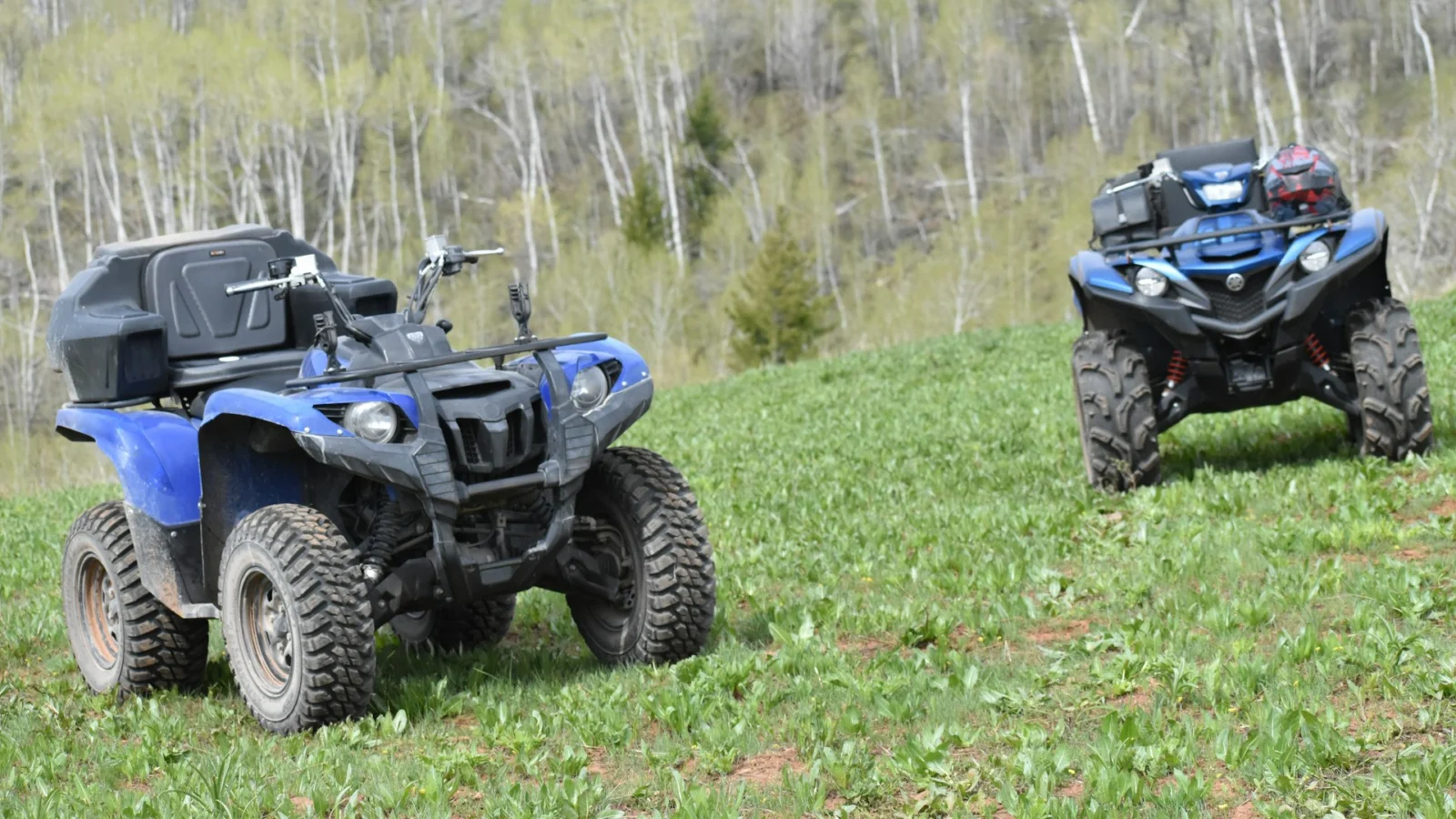
The Yamaha Grizzly EPS and the Kodiak 700 have the same heart: a 686cc liquid-cooled, fuel-injected single driving through Yamaha’s Ultramatic belt transmission with engine braking on all four wheels. What you pay extra for on the Grizzly is the chassis around that engine: more front suspension travel, 26-inch tires, more ground clearance, rear disc brakes, LED headlights and power steering on every trim.
For the 2027 model year, Yamaha lists the Grizzly EPS at $10,599 and the Kodiak 700 at $8,099, or $9,499 with EPS. The fair comparison for most buyers is Grizzly EPS against Kodiak 700 EPS, a gap of $1,100. If you ride rough trails for hours, the Grizzly earns it. If the machine mostly works, the Kodiak EPS does the same jobs for less.
Grizzly vs Kodiak 700 specs side by side
All figures below come from Yamaha’s 2027 US specification pages for the Grizzly EPS, Kodiak 700 EPS and Kodiak 700. The Grizzly EPS and base Kodiak 700 figures are unchanged from the 2025 and 2026 model years.
| Spec | Grizzly EPS | Kodiak 700 EPS | Kodiak 700 (base) |
|---|---|---|---|
| 2027 MSRP | $10,599 | $9,499 | $8,099 |
| Engine | 686cc liquid-cooled SOHC single, 44mm fuel injection | Same | Same |
| Transmission | Ultramatic V-belt, all-wheel engine braking, H/L/N/R/P | Same | Same |
| Drive | On-Command 2WD, 4WD, locked 4WD | On-Command 2WD, 4WD, locked 4WD | 2WD and 4WD, no diff lock |
| Power steering | Standard | Standard | No |
| Front travel | 7.6 in, 5-way preload | 7.1 in, 5-way preload | 7.1 in |
| Rear travel | 9.1 in, 5-way preload | 9.1 in, 5-way preload | 9.1 in |
| Ground clearance | 11.3 in | 10.8 in | 10.8 in |
| Tires | 26 in Maxxis (26×8-12 front, 26×10-12 rear) | 25 in Maxxis (25×8-12, 25×10-12) | 25 in Maxxis |
| Rear brake | Dual hydraulic disc | Sealed multi-disk wet brake | Sealed multi-disk wet brake |
| Seat height | 36.1 in | 33.9 in | 33.9 in |
| Width | 48.4 in | 46.5 in | 46.5 in |
| Wet weight | 701 lb | 686 lb | 659 lb |
| Fuel capacity | 4.8 gal | 4.8 gal | 4.8 gal |
| Rack capacity | 308 lb (110 front, 198 rear) | 308 lb | 308 lb |
| Towing | 1,300 lb, 2 in receiver | 1,300 lb, 2 in receiver | Not listed by Yamaha |
| Headlights | LED | Halogen | Halogen |
What is actually the same
More than the price gap suggests. Both machines share the 686cc engine, the 44mm fuel injection, the Ultramatic transmission with high and low range, the 49.2-inch wheelbase, the 81.5-inch overall length, the 4.8-gallon tank and the steel racks rated at 308 lb combined. On the EPS trims, the drive system is also identical: Yamaha’s On-Command switch for 2WD, 4WD and fully locked 4WD, plus a diff-lock override button.
Towing is rated at 1,300 lb on both the Grizzly and the Kodiak EPS, with a 2-inch receiver standard. Warranty is the same too: a 6-month limited factory warranty plus a 10-year V-belt limited warranty. That belt coverage is worth knowing about, because the belt is the part owners of any CVT quad worry about most. Read Yamaha’s terms before relying on it, since limited warranties exclude abuse and some conditions.
Yamaha’s marketing does describe the engines differently: the Grizzly’s as tuned for recreational trail riding, the Kodiak’s as geared for low-rpm cruising. In practice owners describe the Grizzly as the livelier of the two, but no one buys either for outright speed.
Where the Grizzly earns its price
Front suspension travel and preload. The Grizzly has 7.6 inches of front travel against the Kodiak’s 7.1, with 5-way preload at both ends. Rear travel is the same 9.1 inches on both. Half an inch sounds small, but on a rocky trail at speed the front end is where you feel it through the bars.
Tires and clearance. The Grizzly EPS rolls on 26-inch Maxxis tires and has 11.3 inches of ground clearance, against 25-inch tires and 10.8 inches for the Kodiak. The Grizzly EPS XT-R and Camo go further, with 27-inch Maxxis ‘Zilla tires on 14-inch aluminum wheels and 11.8 inches of clearance.
Brakes. The Grizzly has dual hydraulic discs at the rear as well as the front. The Kodiak uses a sealed multi-disk wet brake at the rear. Discs give a more direct feel on fast, steep descents. The wet brake has its own advantage, covered below.
Equipment. Every Grizzly has power steering and LED headlights. The XT-R and Camo trims add a large all-LCD instrument cluster and a WARN VRX 25 winch. Yamaha also lists three storage compartments on the Grizzly.
All of that suits a rider who covers real distance on rough ground: mountain trails, long hunting days, rutted two-tracks. It is the same conclusion as our full Yamaha Grizzly 700 review.
Where the Kodiak 700 is the better machine
It is easier to live with. The Kodiak’s seat is 33.9 inches high, 2.2 inches lower than the Grizzly EPS. If you climb on and off 40 times a day to open gates, check fence or load a sprayer, that difference adds up. Shorter riders also find the Kodiak easier to handle when it gets stuck or starts to tip.
It is narrower. At 46.5 inches wide, the Kodiak is nearly 2 inches narrower than the Grizzly EPS (48.4 inches) and 2.7 inches narrower than the XT-R. Many public ATV trails restrict vehicle width, so check your trail system’s limit before buying the wider trims.
The sealed wet rear brake. A multi-disk wet brake runs in an enclosed housing, so mud, sand and water do not get at it. For a machine that lives in a barnyard, a creek bottom or a muddy woodlot, that means less brake maintenance than exposed discs.
It costs less. The Kodiak 700 EPS saves $1,100 over the Grizzly EPS at 2027 MSRP, and gives you the same engine, drive system, power steering, racks and towing rating. For work use, that is most of what matters. Our Yamaha Kodiak 700 review covers ownership in more detail.
The base Kodiak 700: know what you give up
The $8,099 base Kodiak 700 is the cheapest way into Yamaha’s 686cc engine, but it drops two things that many owners later wish they had.
- No power steering. On a 659 lb machine with a heavy front rack load, steering effort and kickback on rough ground are noticeably higher. For long days or older riders, EPS is the upgrade that matters most.
- No locking front differential. Yamaha’s 2027 specs list 2WD and 4WD only. For deep mud, steep ledges and plowing snow on a grade, a diff lock is the difference between walking out and driving out.
Yamaha also does not list a towing rating or standard receiver for the base model on its spec page, so confirm the hitch setup with the dealer if you plan to pull a trailer. For flat ground, light chores and a tight budget, the base model still makes sense. For almost everyone else, the extra $1,400 for the Kodiak EPS is money well spent.
Prices for every 2027 trim
| Model | 2027 MSRP | 2026 MSRP | Key additions |
|---|---|---|---|
| Kodiak 700 | $8,099 | $7,899 | Base model, no EPS |
| Kodiak 700 EPS | $9,499 | $9,399 | Power steering, diff lock, receiver |
| Kodiak 700 EPS XT-R | $10,499 | $10,399 | Aluminum wheels, WARN winch |
| Grizzly EPS | $10,599 | $10,399 | 26 in tires, rear discs, LED lights |
| Grizzly EPS XT-R | $11,399 | $11,399 | 27 in ‘Zilla tires, 14 in aluminum wheels, winch, LCD |
| Grizzly EPS Camo | $11,499 | $11,499 | XT-R equipment with camo finish |
MSRPs exclude tax, title, prep and destination charges, and dealer pricing varies by region and season. Yamaha often runs incentives on utility ATVs, so check current offers before you negotiate. One detail worth noticing: the Kodiak 700 EPS XT-R costs just $100 less than the Grizzly EPS. If you want the Grizzly’s suspension and tires more than a winch and aluminum wheels, the Grizzly EPS is the better buy at that price.
Maintenance and reliability
Because the engine and transmission are shared, the ownership basics are the same on both. The belt is the wear item to understand. Use low range for towing, plowing and slow crawling, keep water out of the belt housing after deep crossings, and do not ride at walking pace in high range, which slips the belt continuously. The engine itself has a long record: a version of it also powers the Raptor 700 sport quad, which uses a manual gearbox instead of a belt.
Follow the service intervals in the owner’s manual for oil, final drive and differential fluids and air filter, and shorten them if you ride in dust, mud or water. The wet rear brake on the Kodiak and the rear discs on the Grizzly each need checking at the intervals Yamaha specifies.
Who should buy which
- Buy the Grizzly EPS if you ride rough trails for hours, hunt in steep country, want the bigger tires and clearance, or plan to add a winch and plow and still want trail performance.
- Buy the Grizzly EPS XT-R if you would otherwise buy a Grizzly EPS and then add aluminum wheels, bigger tires and a winch. Yamaha’s package costs $800 more and includes all three.
- Buy the Kodiak 700 EPS for farm and ranch work, property maintenance, plowing, food plots and moderate trails. It is the best value in the pair.
- Buy the base Kodiak 700 only for flat ground, light work and a strict budget.
If you are considering a sport quad instead of a utility machine, the Raptor 350 and YFZ 450R are different tools entirely: lighter, faster, and with no racks, no 4WD and no towing rating. The last check before buying either utility model is simple: sit on both at the dealer. A 2.2-inch difference in seat height is something you feel in the first 10 seconds.
Troubleshooting
Owners also ask
Q1 Is the Yamaha Kodiak 700 the same as the Grizzly?
They share the 686cc engine, the Ultramatic belt transmission with engine braking, the 49.2-inch wheelbase, the rack capacity and the fuel tank. The chassis and equipment differ. The Grizzly has more front suspension travel, bigger tires, more ground clearance, rear disc brakes and a taller seat. The Kodiak is narrower, lower and lighter, with a sealed wet rear brake.
Q2 Which is better, Yamaha Grizzly or Kodiak?
It depends on the riding. For long days on rough, rocky or rutted trails, the Grizzly's extra travel, clearance and larger tires are worth the money. For farm work, plowing, hunting access and moderate trails, the Kodiak 700 EPS does the same jobs for about $1,100 less at 2027 prices, and its lower seat is easier to get on and off all day.
Q3 What is the top speed of the Yamaha Kodiak 700 vs the Grizzly 700?
Yamaha does not publish top speed for either model. Owners generally report the Grizzly at roughly 65 mph and the Kodiak at roughly 60 mph, with the gap coming from tire size and gearing rather than the engine. Actual speed depends on tire size, load, rider weight and terrain, and neither machine is built for sustained top-speed running.
Q4 Does the Kodiak 700 have a diff lock?
The Kodiak 700 EPS and EPS XT-R have Yamaha's On-Command 3-way locking differential with 2WD, 4WD and locked 4WD, the same as the Grizzly. The base Kodiak 700 without power steering has 2WD and 4WD only, with no locked front differential listed in Yamaha's 2027 specifications.
Q5 How much does a Yamaha Grizzly cost compared to a Kodiak?
Yamaha's 2027 US MSRPs are $10,599 for the Grizzly EPS, $11,399 for the Grizzly EPS XT-R and $11,499 for the Grizzly EPS Camo. The Kodiak 700 is $8,099, the Kodiak 700 EPS $9,499 and the Kodiak 700 EPS XT-R $10,499. Prices exclude tax, title, prep and destination, and dealers may charge more or less.
See also
Next in the manual
ATV reviews
Yamaha YFZ 450R Review, Top Speed, Common Issues
The Yamaha YFZ 450R is a 449cc race-derived sport ATV with a top speed around 70 mph and an MSRP typically in the $9,500 to $10,500 range for recent model years. It is a genuine competition machine, which means sharper handling than a trail quad and a maintenance schedule to match.

ATV reviews
Yamaha Grizzly 700 Review, Top Speed, Price, Problems
The Yamaha Grizzly 700 is a 686cc utility ATV with power steering and on-demand four-wheel drive, with a top speed of roughly 65 mph and recent model year pricing typically between $10,500 and $12,500. It is built for work and long trail days rather than sport riding, and its reputation rests on the drivetrain rather than outright speed.

ATV reviews
Yamaha Kodiak 700 Review, Top Speed, Problems, Price
The Yamaha Kodiak 700 shares its 686cc engine with the Grizzly but costs less, typically $8,000 to $10,500 for recent model years, with a top speed around 60 mph. It is a work-focused utility ATV with a reputation for being reliable and undemanding, and it is the value choice in Yamaha big-bore utility quads.