OG-0594 Warning lights
Jeep Wrangler Check Engine Light: Common Codes, Flashing vs Solid, and How to Reset It
7 min read Rev. Sep 29, 2026
Checklist
- Solid light: read the code soon. Flashing light: severe misfire, get service immediately.
- A loose gas cap is a common trigger; JK shows gASCAP, JL has its own fuel cap light.
- EVAP, misfire, thermostat (P0128) and oil pressure sensor codes are common on the 3.6L.
- Any OBD-II reader works; the port is under the dash on the driver's side.
- Clearing a code without fixing the cause only turns the light off until it resets.
- Disconnecting the battery clears codes but also resets readiness monitors for inspection.
- 2012 and some 2013 JK 3.6L misfires may relate to the X56 left cylinder head issue.
Procedure
The check engine light on a Jeep Wrangler, officially the Malfunction Indicator Light (MIL), is the amber engine outline on the instrument cluster. When it stays on solid, the engine computer has stored a fault code, usually emissions related. The Jeep typically drives normally, and Jeep’s owner’s manuals say it will usually not need towing, but you should have the code read within a few days.
When it flashes, the situation is different. Jeep’s manuals for both the JK (2007 to 2018) and JL (2018 on) say a flashing MIL warns of conditions that can quickly cause power loss or severe catalytic converter damage, and that immediate service is required. In practice that means a severe misfire: ease off, avoid towing and hard acceleration, and get it diagnosed the same day.
Solid vs flashing: what to do
| Light | Usual meaning | Can you drive? | What to do |
|---|---|---|---|
| On briefly at key-on, then off | Bulb check | Yes | Nothing |
| Solid, Jeep drives normally | Stored fault, often EVAP or a sensor | Yes, short term | Check the gas cap, read the code within days |
| Solid, with rough running or low power | Misfire, sensor or limp mode | Gently, to a shop | Read codes now; avoid highway and towing |
| Flashing | Severe misfire | Only as far as needed | Reduce load, get service immediately |
| Solid with coolant or oil warning | Engine protection issue | No | Stop safely and shut off the engine |
Jeep’s manuals also caution that prolonged driving with the MIL on can damage the emission control system. A cheap sensor problem ignored for months can turn into a catalytic converter replacement.
Check the gas cap first
The evaporative emissions (EVAP) system periodically pressure-tests the fuel tank for vapor leaks. A loose, cross-threaded or worn gas cap fails that test and sets a code. It is the cheapest fix and a common one.
- JK: the odometer display may show gASCAP before the check engine light appears, according to the 2017 owner’s manual.
- JL: has a separate loose fuel cap warning light in the cluster.
Tighten the cap until it clicks and drive normally. The light does not go out immediately, since the system needs to rerun its test over the next few drive cycles. If it keeps returning, the cap seal or another EVAP part is the likely cause. The Jeep Wrangler gas cap light guide covers this in more detail.
Common check engine codes on Wranglers
These are the codes owners of the 3.8L JK, the 3.6L Pentastar JK and JL, and the 2.0L turbo JL report most often. Code definitions are the standard OBD-II meanings; causes are the usual suspects, not a diagnosis.
| Code | Meaning | Common Wrangler causes |
|---|---|---|
| P0455, P0456, P0457 | EVAP leak (large, very small, cap loose) | Gas cap, purge valve, vent or leak detection components, cracked hoses |
| P0300 to P0306 | Random or cylinder-specific misfire | Spark plugs, ignition coils, injectors; left cylinder head on 2012 to 2013 JK 3.6L |
| P0128 | Coolant below thermostat regulating temperature | Thermostat stuck open, often shows in cold weather on the 3.6L |
| P0520 to P0523 | Oil pressure sensor circuit | Sensor or connector near the oil filter housing on the 3.6L |
| P06DD | Oil pressure control circuit stuck off | Covered by FCA TSB 09-003-25 for some 2022 to 2025 JL 3.6L engines |
| P0420, P0430 | Catalytic converter efficiency below threshold | Aging converter, often after an untreated misfire; exhaust leaks |
| P0171, P0174 | System too lean, bank 1 or 2 | Vacuum leaks, dirty mass airflow readings, weak fuel delivery |
| P0016 to P0019 | Crankshaft and camshaft position correlation | Low or dirty oil, timing components, cam phasers |
| P0299 | Turbocharger underboost | Boost leaks, wastegate or charge pipe issues on the 2.0L turbo |
| P0562 | System voltage low | Weak battery, alternator, poor grounds |
| P2135, P2138 | Throttle or pedal sensor correlation | Throttle body or pedal assembly; often with the ETC light |
Throttle codes usually bring the red lightning bolt as well. If you see that symbol, go to the Wrangler lightning bolt light guide. Coolant temperature codes and a rising gauge are covered in Jeep Wrangler overheating.
The 2012 and 2013 JK misfire to know about
In June 2014, Chrysler announced extended warranty X56 for the left cylinder head on the 3.6L engine, covering 2012 and select 2013 Jeep Wrangler (JK) models among others, for 10 years or 150,000 miles from the in-service date. The condition involved valve guide and seat wear that can cause a misfire and a check engine light, and owners often describe a ticking noise from the driver’s side of the engine.
For most of these Jeeps, 10 years from the original in-service date has now passed, so the extended coverage has likely expired. The history still matters when buying a used 2012 or 2013 JK: ask whether the left head was replaced, and treat persistent misfire codes with a driver’s-side tick as a warning sign. See the Wrangler problems by year guide for the other issues of that era.
How to read the codes
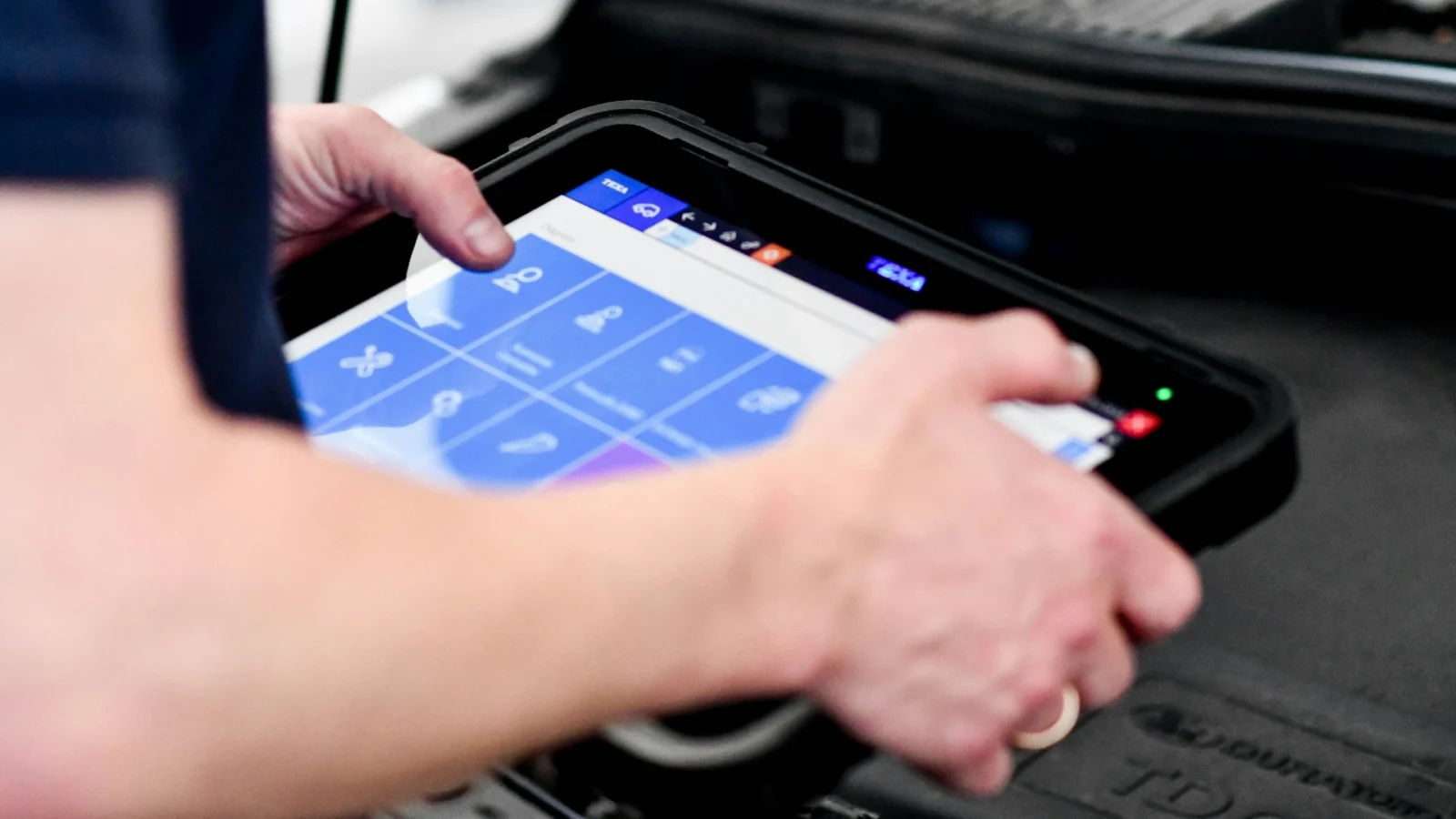
- Find the OBD-II port. On both the JK and JL it is under the dashboard on the driver’s side, near the steering column.
- Plug in a scanner. Any OBD-II code reader reads engine codes. Bluetooth dongles that pair with a phone app work too.
- Turn the ignition to ON or RUN without starting the engine, or start it if the tool asks you to.
- Record every code and its freeze frame data (speed, temperature and load when it set) before clearing anything.
- Look up the code and the likely causes, then check the cheap things first.
Many national parts store chains read engine codes for free. For codes in other modules, such as ABS, airbag or transmission, you need a more capable scanner. That is why a basic reader shows nothing when only the ABS light or traction control light is on.
Many JK owners also use a key-cycle trick to show stored codes in the odometer: turn the key from OFF to ON three times within a few seconds, ending in ON, without starting the engine. It is handy on the trail, but it shows only the code number and does not work on push-button JLs. A scanner gives more detail.
How to reset the check engine light
Fix the cause, then clear the code. Most scan tools have a clear or erase function. If the fault is gone, the light stays off.
Let it clear itself. Once the fault stops, the computer turns the light off on its own after the relevant self-test passes over several drive cycles. This is normal after tightening a gas cap.
Disconnecting the battery also clears codes, but it is the worst option. It resets the emissions readiness monitors, so the Jeep can fail a state emissions inspection until they complete, and it can erase radio and idle settings. On a JL with Stop/Start, Jeep’s manual says both the main and auxiliary batteries must be disconnected to fully de-energize the 12-volt system.
If your state requires an emissions inspection, most test stations plug into the same OBD-II port and check both for stored codes and for completed readiness monitors. A Jeep with the check engine light on, or with monitors not yet ready after a battery disconnect or code clearing, will usually be turned away or failed. After a repair, drive normally for several days, including some steady highway miles, before the inspection so the monitors can complete.
Clearing a code without a repair only turns the light off until the next failed test. A buyer’s scan tool will also show that monitors were recently reset, which is a red flag in a used Jeep.
What not to ignore
- A flashing light. Every mile of a severe misfire sends unburned fuel into the catalytic converter.
- A check engine light with a coolant temperature warning or rising gauge. Pull over and follow the overheating steps in your manual.
- Oil pressure codes with an oil pressure light or ticking. Check the oil level before driving any further.
- Misfires under load while towing or climbing. These get worse, not better, under strain.
- A light after a deep water crossing. Check the air filter and intake for water before restarting repeatedly.
What diagnosis and common repairs cost
Typical US ranges as of 2026. Labor rates vary widely by region and engine access differs between the 3.6L and 2.0L.
- Code read: free at many parts stores; $100 to $180 for a full diagnostic at a shop
- Gas cap: $15 to $40
- Spark plugs, 3.6L V6: $200 to $450 installed, since the rear plugs require removing the upper intake
- Ignition coil: $60 to $150 per coil installed
- Thermostat, 3.6L: $250 to $500 installed
- Oil pressure sensor: $100 to $300 installed
- EVAP purge valve: $100 to $250 installed
- Catalytic converter: $800 to $2,500 or more, depending on engine and whether it is a factory or aftermarket part
Before paying for an engine repair, enter your VIN at NHTSA’s recall lookup and ask a dealer whether any service bulletin or extended warranty applies. Emissions parts often carry longer coverage than the basic warranty, so check your warranty booklet too. The cheapest check engine light is the one fixed early: read it, write it down, and deal with small codes before they become big ones, as part of the regular Wrangler maintenance routine.
Troubleshooting
Owners also ask
Q1 Can I drive my Jeep Wrangler with the check engine light on?
If the light is solid and the Jeep drives normally, yes, for a short time. Jeep's manuals say the vehicle will usually be drivable and not need towing, but prolonged driving with the light on can damage emissions parts. If the light is flashing, reduce speed and load and get it serviced right away, because unburned fuel from a misfire can overheat and ruin the catalytic converter.
Q2 How do I reset the check engine light on a Jeep Wrangler?
Fix the cause first, then clear the code with an OBD-II scan tool. The light also turns off by itself after several drive cycles once the fault stops. Disconnecting the battery clears codes too, but it resets emissions readiness monitors, so the Jeep can fail a state inspection until they complete. On a JL with Stop/Start there are two batteries to consider.
Q3 What is the most common check engine code on a Jeep Wrangler?
EVAP system leak codes such as P0456 and P0455 are among the most common, often caused by a loose or worn gas cap or a leaking purge or vent component. Misfire codes (P0300 to P0306), thermostat code P0128 on cold days, and oil pressure sensor codes on the 3.6L Pentastar also come up often on both JK and JL.
Q4 Why is my Jeep check engine light flashing?
A flashing check engine light means the computer has detected a misfire severe enough to damage the catalytic converter. Common causes are a failed ignition coil, a worn or fouled spark plug, a leaking fuel injector or, on 2012 and 2013 JK 3.6L engines, the left cylinder head valve seat problem. Stop driving hard and have it diagnosed the same day.
Q5 Will a loose gas cap make the check engine light come on?
Yes. The EVAP system tests the fuel tank for vapor leaks, and a cap that is loose, missing or has a worn seal fails that test. On a JK, the odometer may show gASCAP first. On a JL, a separate loose fuel cap light usually appears. Tighten it until it clicks; the light should go off after a few days of normal driving.
Q6 Does AutoZone read Jeep check engine codes for free?
Many national parts store chains in the US offer free check engine code reading, and some will lend or rent scan tools. Policies vary by store and state, so call ahead. A free read gives you the code number; a shop or dealer with a Jeep-capable scan tool can go further and read ABS, airbag and transmission modules.
See also
Next in the manual

Warning lights
Tire Pressure Light Blinking on a Jeep: Meaning & Fixes
A blinking TPMS light and a steady one mean different things. Steady means at least one tire is genuinely low on pressure. Blinking for roughly 60 to 90 seconds and then staying on means the system itself has a fault: usually a dead sensor battery, a failed sensor, or a sensor that was not relearned after a tire change.
Warning lights
Jeep Wrangler Lightning Bolt Light: What the ETC Warning Means and How to Fix It
The lightning bolt light on a Jeep Wrangler dashboard is the Electronic Throttle Control (ETC) warning. It means the engine computer has found a fault in the throttle body, the accelerator pedal sensor or their wiring. If it stays on steadily, the Jeep is usually drivable but needs service soon. If it flashes, Jeep says immediate service is required: expect reduced power, a rough idle or stalling, and possibly a tow.

Chimes and switches
How to Reset the Oil Life on a Jeep Wrangler (JK and JL)
To reset the oil life on a JK Wrangler (2007 to 2018), turn the ignition to ON without starting the engine, slowly press the accelerator to the floor three times within 10 seconds, then turn the ignition off. On a JL (2018 on), select ON/RUN without pressing the brake, open Vehicle Info, then Oil Life in the cluster, and hold OK until it reads 100%. The pedal method also works on the JL.